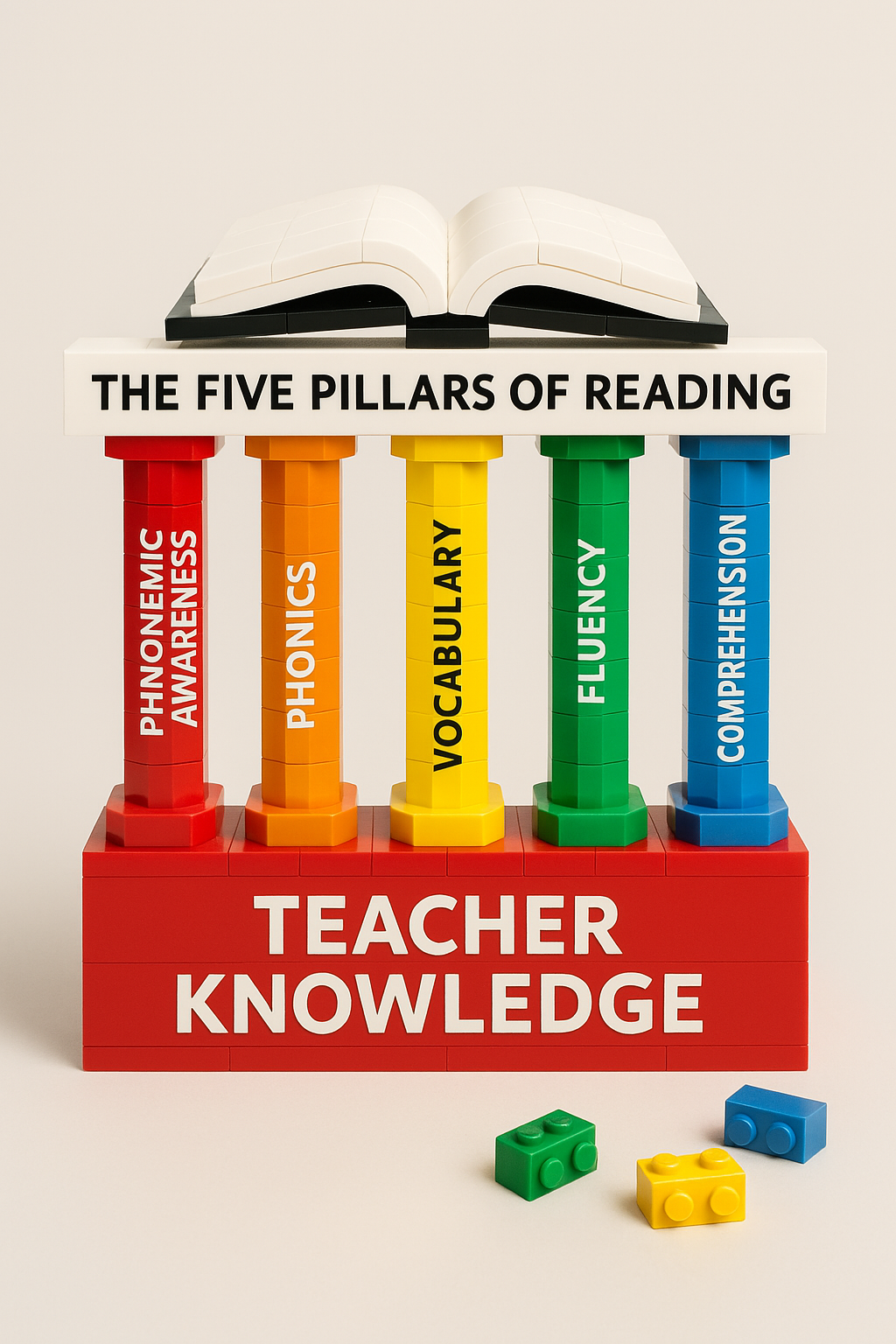
Thanks to decades of research, we now have tools that make learning to read a little easier to navigate. This body of research is known as the Science of Reading. Think of it as a field guide to understanding how we learn to read and the strategies that work best. It’s not a one-size-fits-all approach, but a map made from years of research across multiple disciplines.
In 2000, the National Reading Panel identified five essential pillars for effective reading instruction: phonemic awareness, phonics, fluency, vocabulary, and comprehension. These are the building blocks for teaching kids to read and essential knowledge for homeschool educators. Let’s get a lay of the land and take a brief look at them one by one.
Phonemic Awareness
Phonemic awareness is the ability to hear and play with sounds in words. Think of phonemes as tiny Lego bricks. The word “cat” has three sounds, /k/, /a/, /t/, or three phonemes. The word “books” has four phonemes and two morphemes but I’m getting ahead of myself! Phonemic awareness is the foundation for phonics and it is really important to make it a part of your homeschool curriculum if you have a dyslexic learner because difficulty with phonological processing is most often at the heart of dyslexia. Phonemic awareness is all about hearing the sounds.
Phonics
In the world of structured language, letters and letter clusters are called graphemes. Phonics connects sounds to letters or phonemes to graphemes.
- p says /p/
- sh says /sh/ (as in fish)
The idea that letters represent sounds is known as the alphabetic principle, and understanding this concept—though it may seem simple—is the first major step toward learning to read. Phonics is the focus of the majority of homeschool reading curriculums and while it’s really important it is just one piece of the puzzle of learning to read.
Vocabulary
Vocabulary is essential for understanding what we read. The more words we know, the easier it is to connect meaning to text. My son’s extensive vocabulary, which I attribute to all our years of reading high quality literature out loud, came in really handy as his decoding skills grew beyond basic words. Building vocabulary through reading aloud and experiences makes a big difference.
Fluency
Fluency is the ability to read smoothly and accurately at a good pace with expression. When students can decode words automatically, they can focus on understanding the meaning behind them. It’s kinda like trying to listen to podcast while parallel parking. What did they say? Fluency is the bridge between decoding and comprehension because if a student is too focused on decoding, the meaning can get missed!
Comprehension
Comprehension is the goal of reading. It’s why we read and where all the hard work pays off. Reading without comprehension is kinda like watching a movie without sound. It doesn’t make a ton of sense. Comprehension is where stories come alive and facts turn into knowledge. At first we learn to read and then we read to learn.
References:
(1) Snowling, M. J. (1981). Phonemic deficits in developmental dyslexia. Psychological Research, 43(2), 219–234. https://doi-org.coloradocollege.idm.oclc.org/10.1007/BF00309831